Book Free Demo
Categories
Home Service

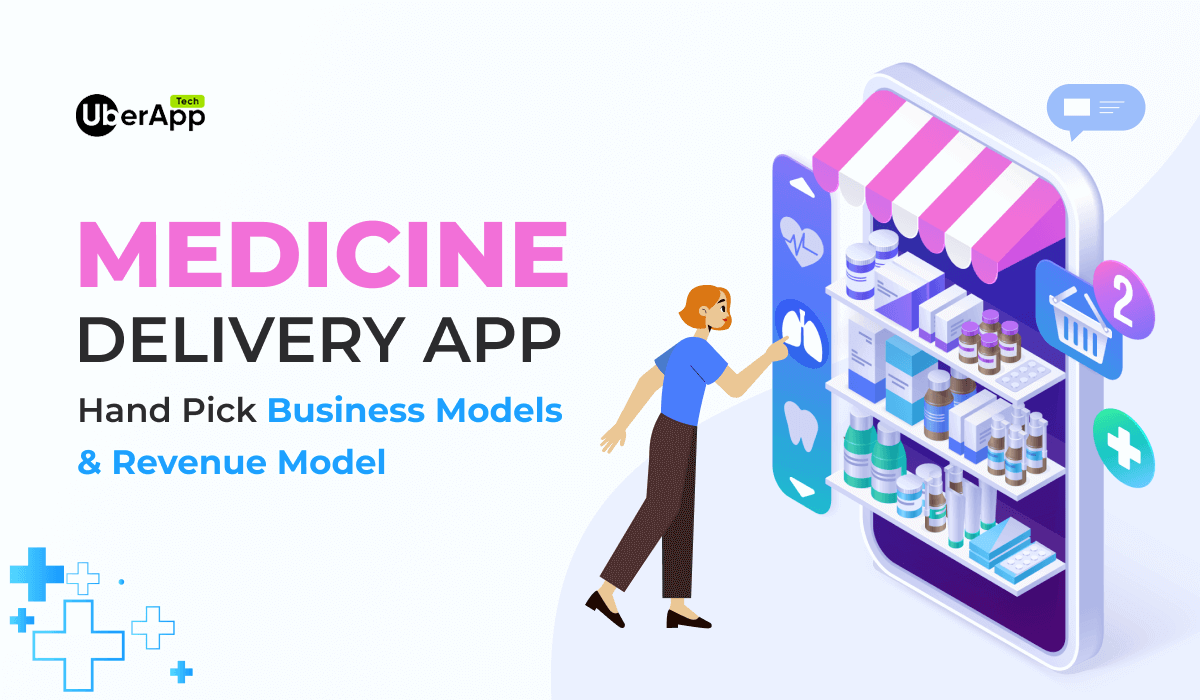
Medicine Delivery App – Hand Pick Business Models & Revenue Model

COVID-19 lockdown played a crucial role in digitizing almost all operational processes in all business industries. As a result, cabs to medicines, all services, and product retail went online serving immense convenience. 

Talking about the pharmacy industry, we see a plethora of medicine delivery apps available online to deliver medicines to the doorstep just like food and other home services. As a result, more and more entrepreneurs are looking forward to developing and launching a pharmacy app. This not just leads you to foster a robust business base but ends up in turning your local business into a leading brand in the marketplace. 

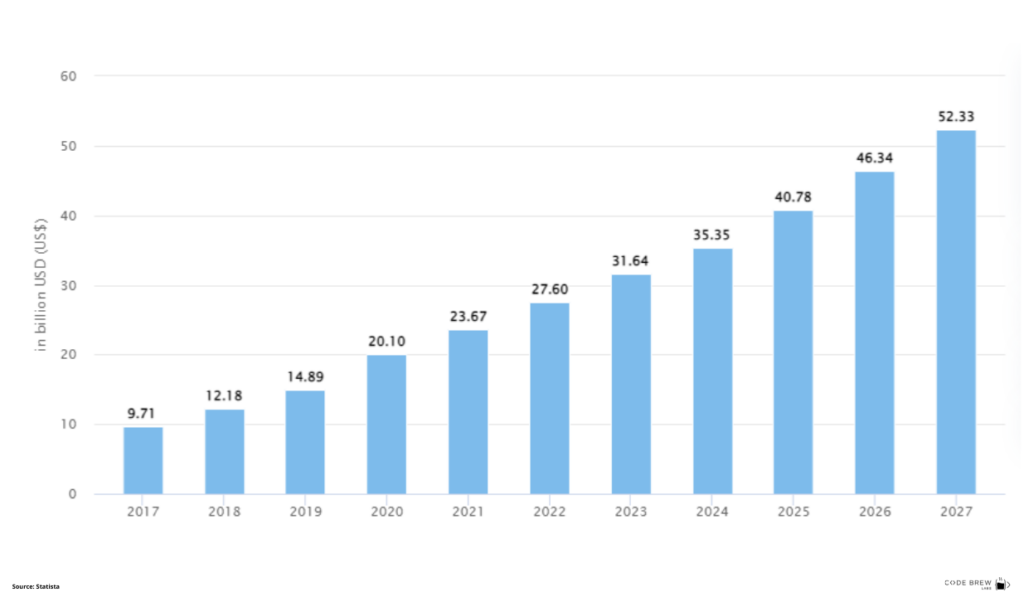
During and post COVID-19, the pharmacy world saw impeccable growth. Many researchers even promised to see a compound annual growth rate of 20% by the end of 2025. It’s when the revenue generation is predicted to reach up to US $27.60bn in 2022 itself. 

By the time medicine delivery apps have gained traction in the local and global markets, we see an accelerating number of medicine delivery clone apps like 1mg clone, PharmEasy clone, Practo clone, and much more. This all ends in a rising demand for on-demand delivery app development digitizing the pharmacy world globally. 

And why not when it has become super-easy and quick to get build and launch a medicine delivery app that gives your business a much-required recognition? Plus, thinking to launch a pharma app won’t ever make you run at a loss. If you are also planning to have a pharma app as yet another asset to your business, let’s take you through multiple business models first. 

Want To Keep It Short & Well-Explanatory? Here’s A Video Explaining Crucial Steps To Launching A Pharmacy Delivery App.

Tried & Tested Business Models For Medicine Delivery App Businesses- 

Business Model – Marketplace

This business model is based on the partnership concept. Here, an online pharmacy portal collaborates with different local pharmacies, without needing to stock up on the medicines in the inventory. Therefore, whenever a customer places an order online, the online pharmacy portal sends the medicine order request to the local pharmacies to check availability. This process isn’t a part of the overall medicine delivery app functionalities. 

Here, the online pharmacy medicine delivery portal acts more like an intermediary platform between the local pharmacies and end customers. The medicine delivery app becomes the primary face of the medicine store for app users to order, track, and pay for the medicine orders placed. 

Since the entire process is automated, this marketplace business model requires little infrastructure with core expertise in managing operational flow. 

Business Model – Operational 

The operational business model is all about a pharmacy retailer launching and running a pharmacy delivery app. Basically, it’s more like an offline pharmacy expanding itself as an online pharmacy delivery service provider as well. 

Customers (app users) get to upload the prescription and place an order for the suggested medicines. Moving forward, end customers are required to choose a specific mode of payment to complete the order placed. This reflects the order tracking ID, order delivery estimated time, and driver’s contact information. 

Revenue Generation Streams For An On-Demand Medicine Delivery App 

Getting an on-demand delivery app developed for your medicine business can prove profit-worthy. But only when you know the right revenue generation streams to include in your online medicine delivery business model. 

Here’s a sneak peek into what we are talking about! 

Commission-Oriented Revenue Model – 

This is one of the most common and successful revenues generation models followed by almost all e-commerce portals these days. The pharma store owner can seek a certain amount of commission on each order placed via the medicine delivery app. Generally, this commission share is charged based on the current market scenario and rates. However, pharma businesses with a good reputation are likely to fluctuate the commission percentage keeping their profit rates higher than usual.

Delivery Charges – 

This one is for a single-store medicine delivery app. Here, the pharma store owner can seek a certain amount over the bill as delivery charges on each order placed. It is a proven method to seek good profit while expanding your medicine delivery market locally or globally. The delivery charges are calculated based on the total amount of medicine order, destination, and availability of drivers. 

Featuring Advertisements – 

Advertising medicines, medicine, or health-oriented products/ads, hospitals, or local healthcare centers via the medicine delivery app has turned out to be a great source of revenue. It’s more like your on-demand app for the medical industry becomes an advertisement platform for the industry leaders. For which you can seek a certain amount as advertising cost on each ad you run or display. 

Why Invest In Medicine Delivery Apps?

The medicine delivery app market is expanding progressively. The biggest proof is current profit growth and future predictions for the pharmaceutical industry. The overall revenue generation is likely to reflect the increased CAGR of 13.65%. Further, this will result in projected revenue of US$52.33bn by the end of 2027

Here’s a quick graph showcasing the revenue growth in the pharma delivery app industry. 
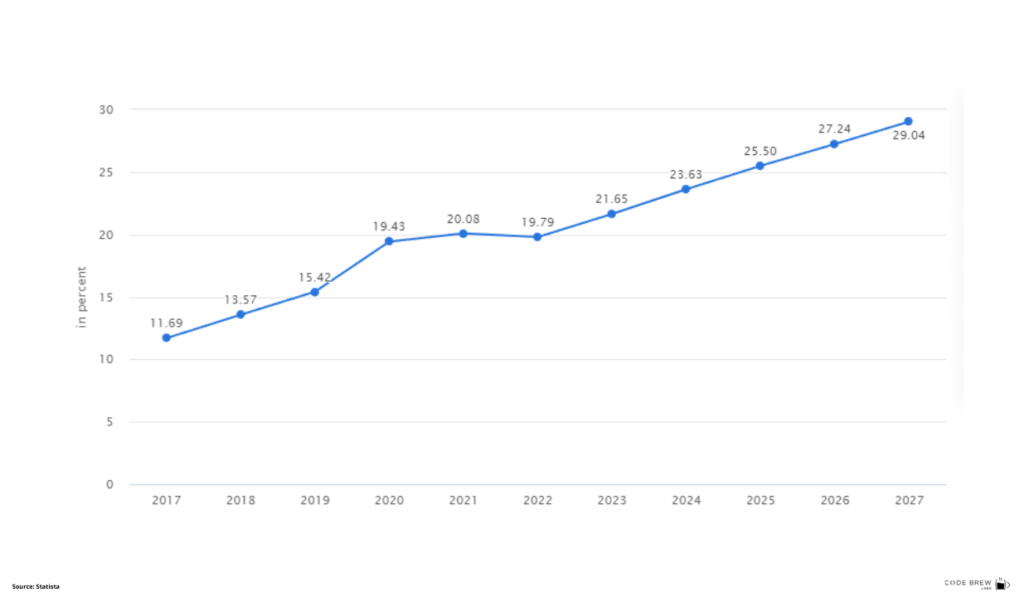
User Penetration In The Medicine Delivery App Market-
Quick Wrap Up 

Deciding on the right revenue and business models for a medicine delivery app like Practo or 1Mg makes more sense when you are entering the market as a newbie. From different business models to multiple revenue generation streams, there’s a lot to evaluate, analyze, and experiment around. 

If you want to keep it simple and quick to get build and run your own pharmacy delivery app, we at Code Brew Labs can be your technology partner. Our approach begins with creating an MVP followed by planning a suitable solution for your business type. 

So, take a step ahead, share your business idea with us, and we ensure to turn your idea into a successful reality! 
Categories
Home Service

GoPuff Business Model: Everything You Need To Know About On-Demand Food Delivery Service

On-demand food delivery services allow consumers to order food from a provider as per their required time and location. The industry has grown rapidly in recent years and the growth has seen even more rapid hike due to stay home restrictions during COVID-19. Some on-demand food delivery services provide a platform where consumers order food from different restaurants or grocery stores and the app contacts the providers after the order is placed. However, other on-demand food delivery services such as GoPuff adopt an inventory based business model.

See Also: 6 Most Efficient Marketplace Business Models To Boost Revenue

History Of GoPuff

GoPuff was launched in 2013 and is headquartered in Philadelphia, Pennsylvania. The on-demand food and grocery delivery platform was founded by two university students, Yakir Gola and Rafael Ilishayev. They started by selling convenience items from the back of their Plymouth Voyager before launching an app in December 2013. The app was then expanded to Chicago and Washington, D.C. before slowly starting operations across 650 cities in US.

Funding Of GoPuff

  • 2016 – GoPuff raised $8.25M in round A funding.
  • 2019 – GoPuff raised $750M from SoftBank with a commitment for additional funding up to $250M.
  • 2020 – The company raised $380M in funding round led by investors including Accel and D1 Capital Partners.
  • 2021 – GoPuff raised $1.15B in a funding round. The funding round was led by investors including D1 Capital Investors, Fidelity Management & Research Company and Luxor Capital.

In 2020, GoPuff announced company’s total value to be $8.9B. Such exceptional growth in a short span after its launch has garnered immense interest from entrepreneurs. If you are also one of the entrepreneurs who wish to launch GoPuff clone, here is an insight into GoPuff business model to help you launch your delivery app like GoPuff.

What Is GoPuff Business Model?

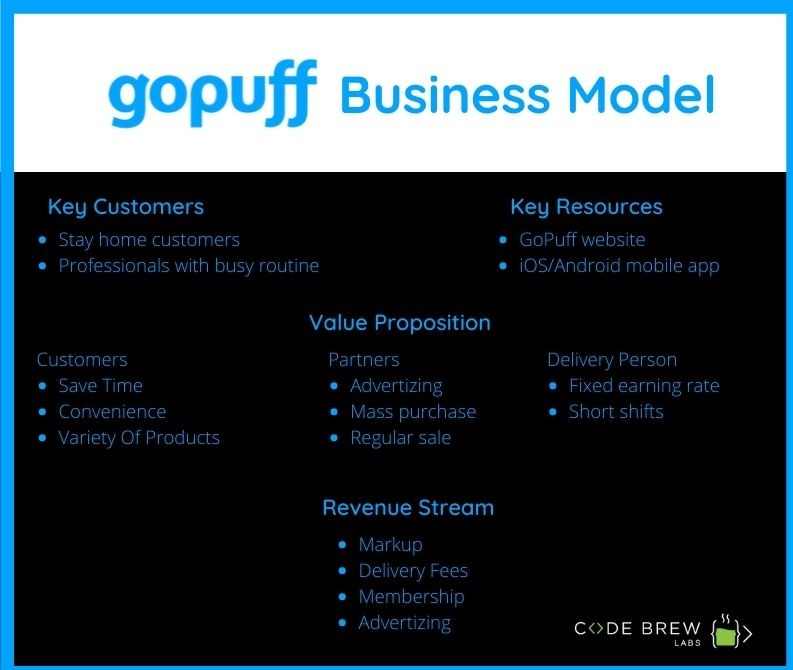
GoPuff business model is an inventory based business model. The on-demand food delivery platform purchases products or goods from different manufacturers. These products are stored in its warehouses. The company has its micro fulfillment centers in different locations to ensure order fulfillment in 30 minutes. Consumers can check the products in the inventory on the GoPuff app to place their order. The price of the products listed on the app includes GoPuff profit and a delivery cost is charged for every order. Let us now discuss different components of GoPuff business model in detail:

GoPuff Business Model

Key Customers: The key customers of GoPuff food delivery app are consumers who cannot step out to purchase food and grocery items for daily use. Such consumers can place their orders at the GoPuff app and receive the products at their doorstep.

Key Resources: The key resources of GoPuff are its website and easy to use app which connect the food and grocery delivery service with its customers.

Value Proposition: GoPuff adds value to its customers, delivery person and the product manufacturers.

Value for customers-

  • Convenience of ordering at any location and time including late night.
  • Save time with fast delivery.
  • A large and expanding choice of products.

Value for manufacturers-

  • Brand awareness by listing on their platform.
  • Regular purchase of products by GoPuff.

Value for delivery person-

  • Earning opportunity by delivering timely orders.

Pros & Cons Of GoPuff Business Model

Thorough analysis of GoPuff business model is important before launching our own GoPuff clone app. So, here is a comprehensive list of pros and cons of the business model.

Pros Of GoPuff Business Model

  • Since GoPuff follows an inventory based business model, it has a fair idea of product availability. The company does not have to deal with out of stock issues after accepting an order which may otherwise arise due to lack of coordination with partner supermarkets or restaurants.
  • GoPuff employs designated staff responsible for picking up the ordered products and handing them over to the delivery person. This saves time as the driver is not required to sift the shelves of a supermarket for completing an order.
  • As GoPuff owns its warehouses, they are kept open late into night. This increases the window of opportunity for GoPuff as it is not bound by operation timings of a partner supermarket.

Cons Or Challenges Of GoPuff Business Model:

  • The company has to invest in warehouse space whenever it expands to a new place.
  • For selling some products such as liquor, it has to apply for special license.

See Also: Top Seven Challenges Faced By Food Delivery Businesses Going In 2021

What Is GoPuff Revenue Model?

GoPuff revenue model has four revenue streams that help GoPuff earn money. Let us take a look at every revenue stream individually.

  • Markup: The first revenue stream of GoPuff is marking up the products. While most of the on-demand food or grocery delivery apps complete their orders by delivering products directly from a supermarket or restaurant, GoPuff purchases products and stores them in its warehouses. When an order is placed, the products are sold directly by the company and the difference between the selling price and the buying plus storing cost is the profit earned by GoPuff.
  • Delivery Fees: This is the second revenue stream of GoPuff. Basically, it’s to cover the delivery cost and not actually a take home profit for the company. GoPuff charges a fixed amount of $1.95 for every order and an additional $2 for orders containing alcohol. However, the delivery fees is void for orders above $49 as in such orders, company generates enough marginal profit to cover the delivery cost.
  • Membership: GoPuff offers a membership program called GoPuff Fam to its customers at $5.95 per month. This is a major revenue stream for GoPuff and the company motivates the consumers to subscribe to this membership program by offering benefits such as free delivery on all orders and other member only discounts.
  • Advertizing: With a large number of consumers every month, being placed first in a product category on GoPuff platform can be extremely valuable for any brand. GoPuff uses this opportunity as a revenue stream by selling priority placements on its on-demand food delivery platform. As per a report by Forbes, GoPuff generated $600,000 by priority placement of Nightfood, a New York based ice cream startup.

See Also:

How To Boost Revenue For Your Food Business Like Uber Eats?

Food Startup Lessons To Take From Grubhub

Summing Up:

GoPuff is an on-demand food and grocery delivery app that has expanded to 550 cities in just 7 years since its inception in 2013. This article sheds light on the inventory based GoPuff business model and different streams of GoPuff revenue model to help entrepreneurs like you in launching GoPuff clone app. Before launching your own on-demand food delivery service like GoPuff, you need to research more about queries such as how to launch an app like GoPuff, features of GoPuff clone and cost of building an app like GoPuff. Fret not! We at Code Brew have answers to all your queries and have all the resources to help you launch your GoPuff clone with advanced features at a low cost. Let’s connect now!

Categories
Home Service

Multi Vendor Home Service Marketplace Builder

Categories
Home Service

On-demand Home Services Apps: The Next Big Trend

With lives becoming increasingly faster and people’s need for a comfortable access to services at home, on demand home services are becoming greatly popular. A simple example here would be the comparison between the online market that exists today, v/s the one that existed almost a decade ago. The digital scenario has shifted massively with the internet era and only the businesses providing an extra edge will survive the competition. 

In the past few years, companies like UrbanClap (now Urban Company), Uber etc. are reaping benefits of their labour. 

According to a report by the New York Times, the US on-demand home services sector currently stands at $600 billion. Also, it is showing a steadfast growth during the forecast period and is projected a CAGR of almost 49% by 2021. 

The present generation being the largest consumer of the internet is also the largest consumer of the on-demand home services. And this will further result in incredible market growth in the coming years.

Another pivotal reason why on-demand apps are becoming increasingly popular is the invariant connection that is established directly between a seller and a customer. Moreover, there are plentiful low cost solutions that can help setting up an on-demand delivery app. Because of this, even the smallest of startups with meagre budgets can set up their business and be running in no time.

CHALLENGES THAT ON-DEMAND APPS COMBAT

UrbanClap, TaskRabbit, or HouseJoy, these startups have become a huge success in the on-demand home service industry. They have brought a revolution with their business model innovations and awesome apps.

Availability of Service Providers: 5 years ago, when these apps weren’t as popular, if I had to look for a plumber, my instant reaction would’ve been NOPE! Right now, I would only download an app on my phone for whatever service I need and choose a service provider. 

Reliability and Quality of Service: With an array of verified service providers that are masters of their silos; and customer reviews about their quality of services, customers can make an informed decision. 

Simplistic Appointment Scheduling: App users easily select the time slot they wish to get a service done; and thus further connect them to a service provider available at the time. 

Multiple Payment Models: Mobile apps bring a flexibility of payment gateways with them. Any on-demand home services app you pick today will at least offer payment via a credit/debit card, net banking and a digital wallet along with a cash mode of payment.

Better Lead Generation: On-demand home services apps create better chances of lead generation for service providers by connecting them to larger audiences. 

STATS AND PROJECTIONS 

  • The On-demand Home services market gained a year-by-year growth of 30.14% in 2018. 
  • The On-demand market revenue for home services will hit $869.95 Billion in between 2017 and 2022, with every segment of the market contributing to the overall revenue generated.
  • The landscaping segment generates annual revenue of about $50 billion and employment of around 900k people in the United States only.
  • The moving and storage market has around 8,000 companies involved who produce around $12 billion of collective revenues.

However, some predictions also suggest that a major market share might remain confined to only the top market players. 

So if you are considering developing your own on-demand mobile app, here are a few things you must consider and questions you must ask your app developer if you wish to succeed in the on-demand home services app market. 

What is my User Persona? 

Since customers are primary to every business, it is important that you understand your users first hand. So at the very onset, you need to gather complete information and in-depth knowledge about your customers- their age, needs, location and expectations from your product specifically.  This will give you complete clarity on your target audience and establish better clarity of your goal.

Who are the top players and what are they doing? 

A competitive analysis of who your top competition is and what they’re doing with their on-demand mobile app will help you figure out what is keeping your clients hooked to their solution. This will further capacitate you to add the missing pieces to your customised solution for your app needs.

What user experience am I creating?

Your app users need to believe that your solution is their solution. It is core to the success of a business like this to keep users hooked to the app. And which is why, a smooth app UX is another important thing that needs your attention and focus. On-boarding and user experience you introduce with your app will be key to user retention. 

What are my User Engagement methods? Am I sending notifications?

Push notifications act as reminders to users; and must thus be an important feature that should be included in your app features. They encourage users to interact with the app more often and thus improve chances to perform an action on the app. Along with user engagement, Push Notifications are essential to disseminate marketing material like special deals and offers. 

What is the tech stack I’m using and what is the development cost? 

Last but not the least, you must be well informed of the tech stack will be used to develop your on demand home services app; and the costs involved therein. It does no harm to schedule a free consultation with an app development company or hire a developer who actually gives a clear picture of the workflow involved and be available to answer all your questions. 

Planning to Launch Your Own Branded Home Services App like TaskRabbit, Urban Company or Thumbtack? Book Free 1:1 Demo with Our Experts Now!

Categories
Home Service

Thumbtack Like App: Next Big Thing In The On-demand Home Services Industry

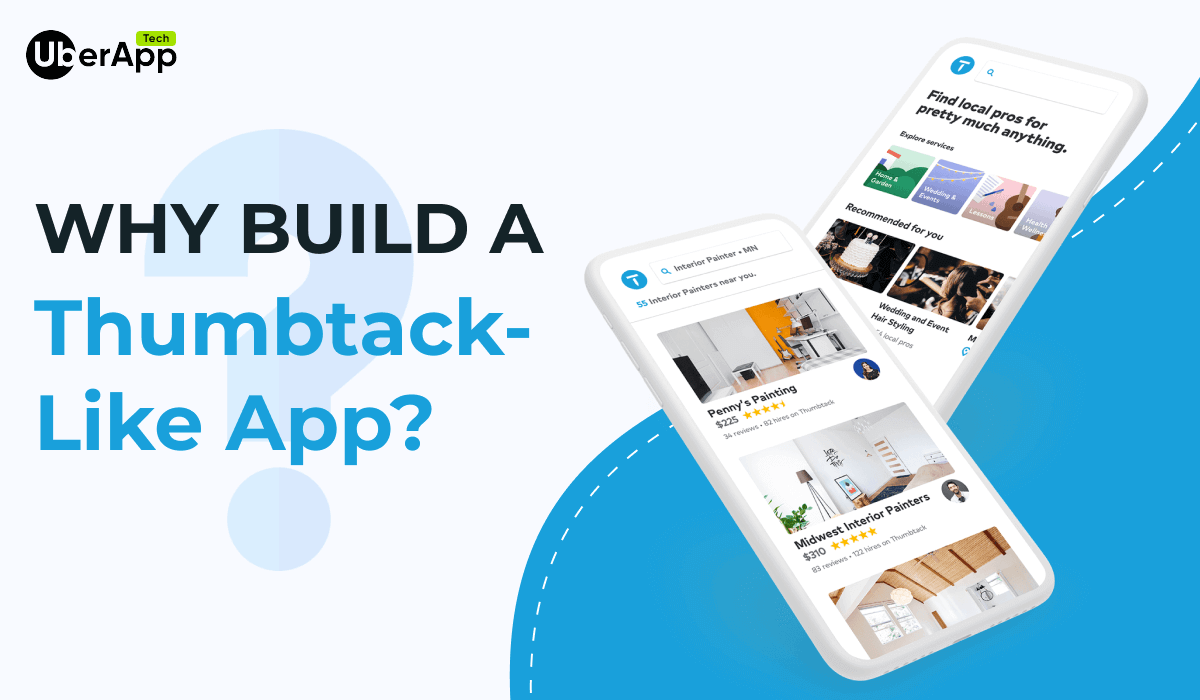
Recently, Thumbtack raised $275 Million in funding. Started back in 2009, this successful online home service marketplace has set new parameters for emerging business owners & entrepreneurs. 

Empowering homeowners to instantly and confidently hire the right skilled professionals, apps like Thumbtack are making their mark.Right from fixing, maintaining, and improving their homes, on-demand home services apps aim to make homeownership simpler and less stressful. On the contrary, professionals like carpenters, handymen, painters, plumbers, outdoor cleaners and many more get a seamless platform to offer their services online. 

Building your own home services app like Thumbtack can be a life turning decision. Here’s an infographic to help you start with the same.

Categories
Home Service

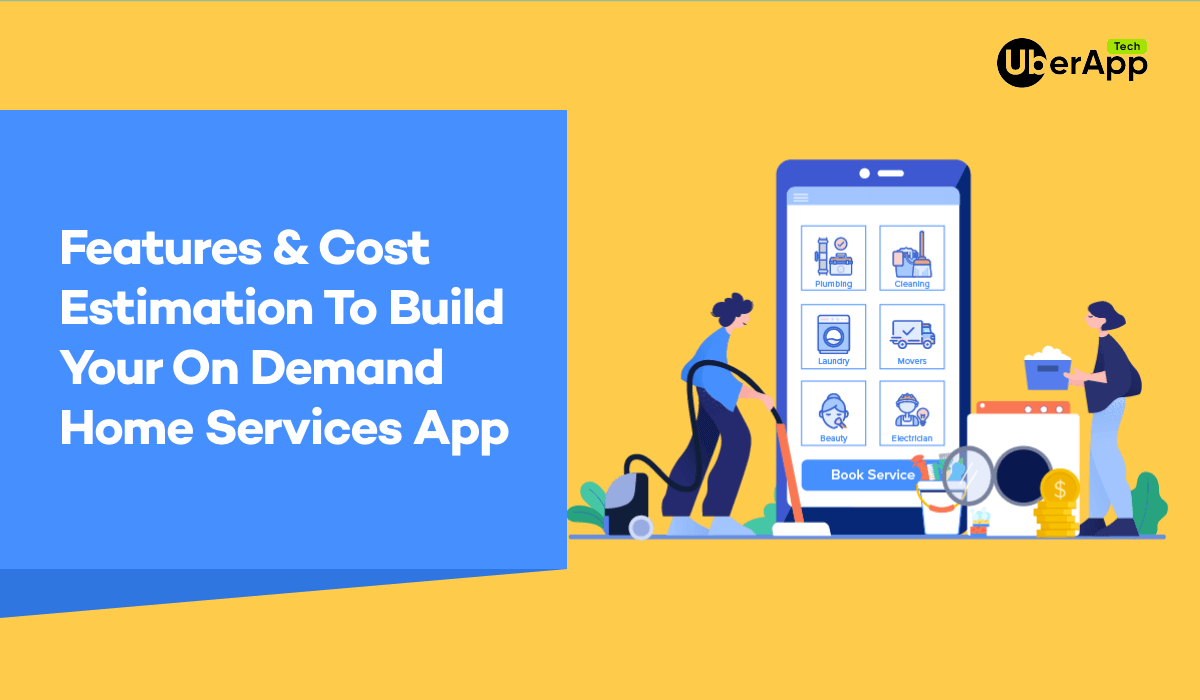
Guide To Create On Demand Home Services App: Features & Cost Estimation

On demand home services app are not a buzzword anymore. Apps like Thumbtack, TaskRabbit & UrbanClap (now known as Urban Company) have turned life simpler for both- customers and service providers. Right from booking home salon services to getting AC or refrigerator repaired, everything is just a tap away. 

In fact, post COVID the rise in on demand home services has increased drastically. As per the reports, the potential market worth is USD 4730.31 billion during the year 2021-25. The market is expected to grow at a CAGR of 70.5%. This has made more business owners and entrepreneurs to invest more in the booming on demand home services industry.

If you too have plans to start your on demand home service app, it is worth understanding:

  • How apps like Urban Company & Thumbtack makes money?
  • What are the important features to launch your on demand home services app?
  • How much it cost to build home services apps like Urban Company & Thumbtack?

So, without waiting anymore, find your answers one-by-one here.

How On Demand Home Services App Makes Money?

Let’s understand this with the example of a popular on demand home services app – Urban Company. Formerly known as UrbanClap, this platform started back in 2014. By the year 2019, the company reported a growth of 150%  and the revenue jumped further by 103% in 2020.

Generally, these on demand home services apps make money through two different models: 

Commission-Based: The company acts as the middleman between the service provider and the customers. The service provider has to pay a certain commission to the company when the customers complete the order. 

Lead Generation: Certain requirements might not be listed on the app or what if customers need these services for a longer period of time. In such a case, the on-demand service provides leads from experts to their customers and charges them both for lead generation. 

The industry has seen a drastic rise in the number of customers who are actively looking for efficient services like these. To help you understand better how Urban Company works paved the route to success, we have shared everything here.  

What are the Features of On-Demand Home Services Apps?

Online home services platforms offer various features for the customers, admin and service providers. Let’s check them one by one.

Features for customer booking app

  • Quick Booking: Customers can quickly register using the mobile app. The companies give options to register or sign up via mobile number, email or Facebook. After the signup process, customers can quickly book the services sorting their requirements. 
  • Instant Notifications: Real-time notifications can help increase customer retention rates. Without navigating to the app, customers can know the status of their orders. 52% of users look for relevant information and offers in the push notifications they receive. Hence, the notifications can also be used for sending the promotions and latest deals and discounts. 
  • Easy Browsing: One of the major USPs of the on-demand services is the ease of browsing to a specific service. Customers can quickly navigate to the services and use the filters provided to get their service. 
  • Rating & Review: This feature is really helpful for the new customers willing to take up the services. The existing customers can rate the services provided to them. Thus, the new customers can choose highly-rated professionals for their services. 
  • Payment Management: Customers can choose to pay via credit card, debit card, Paypal or any third-party wallet after the service provider has accepted the order. After the payment, the service provider will book the date and time slot for the appointment. 

Features for admin dashboard

  • Comprehensive Management: This offers a bird’s eye view to the business owners to manage and track every aspect of their home services from a single dashboard.
  • Promotion Management: For an effective marketing campaign to run, you need promotions in the form of regular discounts and offers. The on-demand services marketplace lets you create robust discounts and deals which increases brand visibility. 
  • Listing Management: It allows business admin to keep control over the service listings and providers one their home services app. They can add any number of services, providers, set their pricing, taxes, and more.
  • Analytics: If you are an admin and want to keep an eye on your progress, the analytics feature is a must-have. Admins can get an insight into the most popular services, customers registered and orders completed. 
  • Feedback Management: This gives control to the admin to warn the service providers with negative customer feedback. This helps admin to filter only the best professionals and guarantee flawless services to the customers. It helps them find gaps and improvise.
  • Manage Discount & Promotions: Business owners can create multiple discounts, promo codes, discounts, etc. to engage and retain their customers. You can run any number of promotional campaigns to grow your ROI.

Features for service provider app 

  • Easy Registration: The onboarding process must be seamless and quick enough to get the service providers on-board. Once the registration process is completed, the service providers must be ready to work.
  • Real-time Chat: There should be an in-built chat system for the service providers to interact with their customers in real-time. Customers can solve their queries and get the required assistance with such a feature. 
  • Route Optimization: The route optimization option is a prerequisite for service providers to ensure faster delivery of the services. This feature gives the shortest and fastest route to ensure on-time arrival and cost-efficiency. 
  • Track Earnings: Vendors can keep a check on their monthly, weekly or yearly earnings using this feature. They can track the transactions and get the cost estimation for each service provided. 

These are some of the essential features to run your online home services marketplace. In case, you need a complete feature book to outshine your on demand home services app, download here.

How Much It Costs To Build On Demand Home Services Apps?

When it comes to the cost, it depends on various factors like feature requirements, technology, platform, etc. The hourly price for hiring on demand home services app developers varies too. For example, the hourly rate in regions like Europe or America is $150-200 per hour. However in Asia, the development cost for your home service application can cost about $80-$130. To sum up, the key factors determining the cost are:

  •         App Platform Required
  •         Selected Theme Design
  •         Content Inclusions
  •         Developer Hired
  •         Features Included
  •         Hosting & Maintenance Costs

In all, the estimated cost of creating an app like Urban Company clone can cost around $15,000-$25,000. However, adding advanced features and functionality might increase the same up to $45,000. 

While you are all set to build your on demand home services app, make sure to have a right tech partner by your side. Choosing a reputed home services app development company like Code Brew can help you navigate your next. With a dedicated team of experts and experience of building over 5,000 successful businesses, your business idea is in safe hands.  

What about having a free consultation with industry experts to build your on demand home services app? Get in touch now!

Planning to Launch Your Own Branded Home Services App Like Thumbtack? Check out Live Demo:

https://www.youtube.com/watch?v=AL2JjI6rlbk&t=866s

Wait! Looking To Build An App Like Uber?

It's Time To Convert Your Uber Like Business Idea Into Success!

Get Free Consultation From Top Industry Experts:
gif
I would like to keep it to myself