
Book Free Demo
Categories
E-commerce

How Much Does it Cost to Build an Ecommerce Marketplace in 2022?

When talking about the most promising and successful business ideas of the present age, you can’t skip on an ecommerce marketplace. Its apparent reason is the seamless revenue generation cycle of Etsy, Amazon, eBay, and many other giants running worldwide. 

In no time these ventures have turned out to be giant eCommerce marketplaces with customers in millions. Now, the fact that Amazon has up to 200 million users with net sales revenue worth 469.8 billion USD may sound enough to make you believe the former statement. Plus, eBay witnessed revenue growth of 14% last year. 

All this makes the business world curious to be a part of the online business marketplace industry. And further, it pushes many entrepreneurs to find an answer to ‘how to launch an eCommerce app like eBay or Amazon. 

If you hunting for the same, we have some must-to-read facts and insights for you. Today from discussing the cost to build an online marketplace to multiple features fluctuating its cost; we will unravel it all for you. All you need is to keep your eyes glued till the end. And we ensure you of getting a reliable app development roadmap ready in your head. 

So, let’s get started! 

But wait, let’s begin with a quick video giving you a sufficient overview of building an ecommerce marketplace.

Types of Ecommerce Marketplaces to Explore:

An online marketplace is a virtual shopping platform connecting sellers and buyers. It comes with multiple features and functionalities adding to the user’s experience. It may interest you to know that such eCommerce marketplaces soon become a good source of branding. Plus the overall success rate of an online marketplace depends on its pre-defined structure, participants, and overall business model. 

This makes it essential to understand the types of online marketplaces. 

Online Marketplace Classification on Business Model Plans:

It’s essential to understand the nitty-gritty of its business model before hopping on the ecommerce marketplace cost-related parameters. Thus, a full-fledged business model will help you implement successive monetization strategies. Let’s explore them:

  1. Global 
  2. Vertical 
  3. Horizontal 

Wondering the difference between vertical and horizontal e-commerce marketplaces? Let’s get insights. 

Horizontal Online Marketplace:

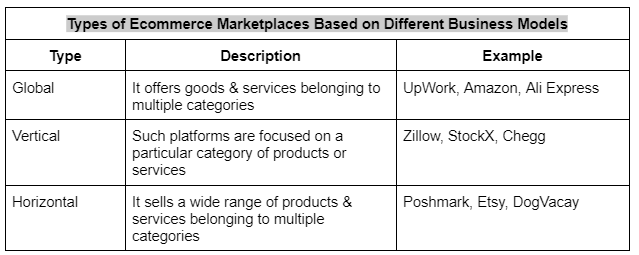
Horizontal marketplaces are all about delivering a wide range of services & products belonging to different categories. Therefore such eCommerce marketplaces can be referred to as a one-stop-shop. One of the biggest examples can be Amazon.

Vertical Online Marketplaces:

This one carries a completely different concept than the above one. Vertical marketplaces are known to sell products or services belonging to a specific category or niche. You can consider Airbnb as an appropriate example.

Global Online Marketplaces:

The global marketplaces are not restricted to specific geographical locations. Such platforms cover the complete exchange of goods and services beyond any geographical restrictions. Therefore it tends to target the target audience globally. 

Etsy is one of the global marketplaces dealing in a series of vintage and handmade supplies sold worldwide. Here is a quick table to give you a clearer picture of the concept.
Types of Ecommerce Marketplaces

Ecommerce Marketplace Classification on Participants’ Parameters:

The best thing about online marketplaces is they can be segmented into different categories on the basis of participants involved. Generally, this encompasses 

  • B2C
  • B2B
  • P2P marketplaces. 

Such classification parameters are considered important to decide the overall cost of building an online marketplace. 

B2C Marketplace:

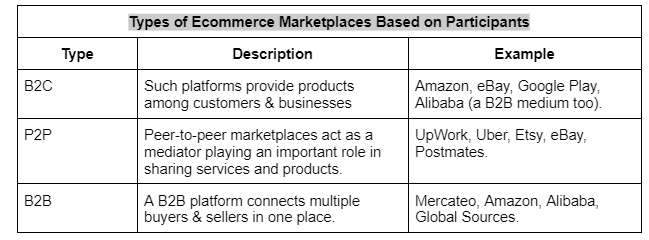
B2C is a business-to-customer eCommerce model. It implies a thorough exchange of products or services between sellers and buyers. B2C mediums are more reliable on emotional responses of the brand as compared to the true value of products or services sold. One of the biggest examples of this marketplace can be Bonanza. 

B2B Marketplace:

B2B is referred to as the business-to-business marketplace model. Here, the goods and services are exchanged between two or more businesses. This allows businesses to connect with different sellers and buyers at the same time. You can consider Alibaba Express as an appropriate example. 

P2P Marketplace:

It’s a peer-to-peer marketplace that is often referred to as a multi-vendor virtual spot. These platforms work as a mediator among commercial people owning similar products or those who wish to purchase the same kind of goods or services. A P2P platform is all about sharing a series of products and services in one spot. Here, Uber can be seen as a perfect example. 
Types of Ecommerce Marketplaces

How to Develop a Marketplace Website?

Now that we have explored what is an online marketplace and what are its different types. Let’s turn the page to how to begin building the best online marketplace to ensure the best success rate for your business. 

Ready-to-Use Solution vs Customized Marketplace Development:

Building an online marketplace comes with a deep understanding of the software, required functionalities, and much more. For this, you will need to choose from two options, including

  • Custom software 
  • Off-the-shoulder solution 

Let’s discuss in-depth. 

Ready-to-Use Solution:

If you are one of those who can’t wait to have your hands on the best online marketplace, choose an off-the-shelf solution. No wonder most entrepreneurs run after ready-to-use software but as compared to the custom ones. Usually, this is to skip the hassle of the wireframe making, development, and testing phase. 

On the contrary, an off-the-shelf solution may carry some drawbacks like-

  • Competitors using the same template leave no unique factor behind 
  • Customization limitations restrict you to add a tinge of branding to your final product. 

Building an Online Business Marketplace from Ground:

Your desire of running a personalized online marketplace will only be fulfilled when you opt for a custom eCommerce marketplace development from point zero. It lets you have complete control over features & functionalities you wish to infuse. 

Remember, a tailored solution demands better resources, which may accelerate the overall cost of an online marketplace website. But then the slog is going to reflect in the success rate indeed. 

When dreaming of an eCommerce marketplace, you need to choose between hiring a:

  • Software development agency 
  • In-house developers 
  • Freelancers 

Now you must be stuck somewhere at the ‘quality’ aspects. Well for that you should prefer outsourcing the first option (software development agency). The apparent reason is robust work exposure, a pool of professionals working on your project, timely delivery, and whatnot. 

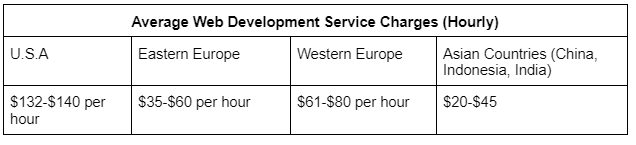
Coming to the remuneration factors, outsourcing a software development agency may cost you high but at the same time, you open gateways to professional development services. Additionally, the exact development charges may vary depending on the location. Where a developers’ team from the USA may charge you up to $100 per hour, you are likely to get similar services at lower prices from countries like India, China, etc. 
avg. price of solution development services

Technology Stack to Build the Best Ecommerce Marketplace:

Deciding on a robust technology stack directly reflects in reliable eCommerce marketplaces built. This is because different programming languages chosen decide the maintainability and overall performance of the software. A wrong choice can lead to poor page load speed or navigation issues forever. 

Let’s take a deeper dig into this concept. 

Backend Development:

Backend development literally backs your product. Thus, it should be made sustainable. Generally, developers recommend Ruby on Rails, MySQL, Sidekiq, etc. to develop the server-side of the product. 

Frontend Development:

It concerns the UI (user interface) adding high chances of better performance & product stability in the marketplace. Thus, the recommended technology stack for the frontend includes CSS3, React, HTML5, Vue.js., JavaScript, etc. 

After the technology stack comes the line of features & functionalities of the online marketplace. This plays a crucial role in deciding the overall cost of the eCommerce marketplace platform for you. The simple mantra is – 

more features = more price. 

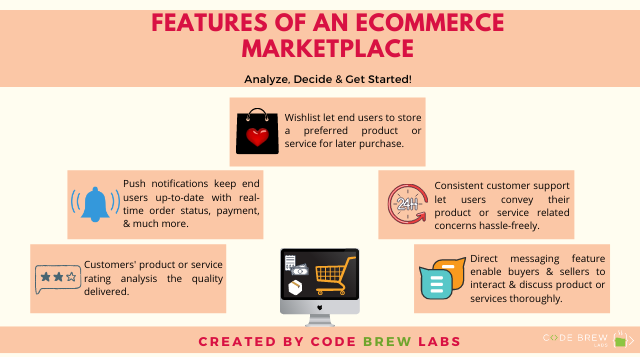
Thus put great emphasis on the features you require. To give you a fair idea of this concept, we have drafted a string of a few mandatory features to consider. 

Ecommerce Marketplace: Features & Functionalities 

A piece of advice: Don’t forget to evaluate your business needs when deciding the features to include.

Factors Impacting the Cost to Build Online Marketplace:

Let’s explore a breakdown of all factors adding to the online marketplace cost. 
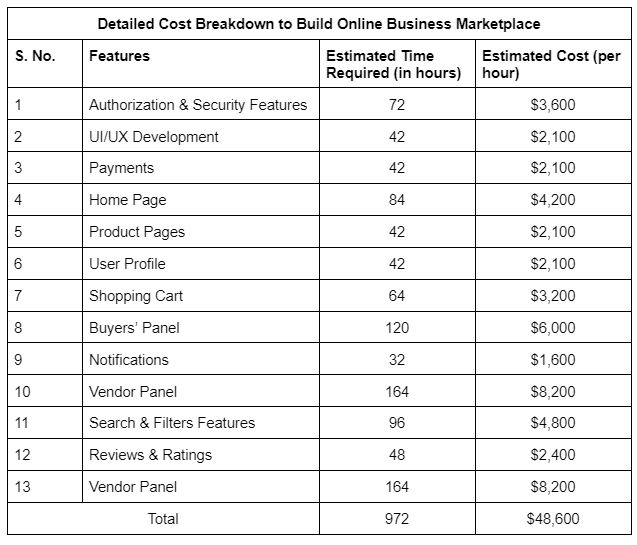
cost breakdown of ecommerce marketplaces

Parameters to Consider an Online Marketplace Development Agency:

Believe it or not, professionals have the true potential to drive the required loyalty of their end customers. But here the challenge is how to find and outsource the best online marketplace development agency? 

Maybe these factors will help you craft an appropriate screening process. 

Expertise:

Remember, the ‘know-it-all’ strategy won’t work if you desire to have a full-proof working online business marketplace for you. This is because no one can be perfect in everything you demand. Thus, search for an agency putting multiple filters. What we mean is to narrow your search. 

Hunt for agencies offering similar services or hold experience in the same. It will give you sufficient scope and reasons to make up your mind. Additionally, you will have an opportunity to look through their previous works. 

Industry Recognition:

Don’t drool over the work shown. Consider checking the market reputation as well. Here, we mean is to evaluate if the agency holds any certifications or recognition from the industry leaders. 

Operational Approach:

Since the developers’ operational approach differs, clarify beforehand what workflow the agency prefers. Talking about the current market trends, most agencies and companies run agile methodology to achieve goals more appropriately. The overall operational approach can be judged on factors such as – work control, flexibility, effectiveness, time-saving thought process, etc. 

Quality Assurance & Post-Deployment Maintenance:

Ensure that the agency consists of a quality analysts team along with experienced IT professionals to handle post-deployment maintenance hassle. Further, it can act as a reliable approach to waving off bugs, product quality issues while saving you a whopping amount. 

Clients’ Reviews:

If you fail to hear it from them, hear their brand advocates. Here, we are talking about client reviews. Thus, it can be considered as a straightforward and true way of seeking agency insights.

How Code Brew Labs Can Prove Helpful Here?

At Code Brew Labs, we have been developing online business marketplaces for multi-sized clients ranging from startups to Fortune 500 companies. Here, the major focal point remains on a product that tenfolds the business growth while proving as a legit asset for the client. 

Moreover, we value your time thus have white-label applications and software ready for you in advance. So, all you need is to share your unique expectations and leave the rest on us. Furthermore, this has helped us save time for our esteemed clients and deliver a product meeting their expectations. 

So, if you have got an online marketplace idea, we are here to turn it into reality. Let’s connect and brew a successful online marketplace for your venture. 

The bottom line is – 

The thought of building an online marketplace is likely to bring you down to the question ‘how much does it cost to build an online marketplace?’. Thus, you need insights about the required set of features & everything else contributing to the complete cost of a solution. 

Starting off with the nitty-gritty of an eCommerce marketplace is likely to take you forward in the right direction. Still, if you feel like sticking somewhere, we are there to assist you! 

Keep brewing great business ideas!
Categories
E-commerce

Top Six eCommerce Marketing Strategies You Should Consider For Your Online Store

eCommerce marketing strategies are the need of the hour going in 2021. These strategies can take up your eCommerce store to a new level of success when employed intelligently. But if one does not know how to use them, their marketing strategies and their online business can fall flat on the face. They need a proper eCommerce guide for that.

eCommerce marketing strategies involve highlighting your products and services so that the right customer can find you. Using the strategies correctly can enable you to stand your place in the tough competition. These strategies can make people want to find you, and also help you reach your target audience easily.

This blog highlights the use of eCommerce marketing strategies to help your online store grow by leaps and bounds. Let’s get started.


1. SEO

When it comes to marketing, search engine optimization (SEO) is the most essential thing to work on. By using the correct SEO tools for your website, you make sure that the products on the website use the right keywords. These keywords are important since the customer uses these keywords to search for the product.

For this, keyword research should be conducted to see what kind of search queries and phrases are being used by your target audience. Also, emphasize the dialect differences, because this can affect the results of the search. This is one of the most effective and efficient eCommerce marketing strategies.

2. Post Reviews

How will a customer know whether the product you are selling is worth buying?

The answer is, by the reviews other people are posting on the product page of your website! A new customer will only trust your store and its products if it has reviews from a real customer. Using the power of word-of-mouth marketing is one of the best strategies to grow your online business.

A positive review of your product can turn a visitor into a customer. If your online store is made in Shopify or WordPress, you can use various plugins to incorporate the product reviews from other customers.

3. Content Marketing

So many businesses think that to do content marketing, blogging is the only way. But this is not the truth. Content marketing also includes lead generation through ebooks to encourage the customers to sign up on your website.


Content marketing is one of the most important strategies to grow an online business.


If you know the ins and outs of content marketing, you can do it yourself. But generally, businesses hire content marketing strategists to do the job better. The blogs that you write should not be about the products you have.

Instead, if your store sells outfits, make sure you write about the type of outfits one should have in their collection. People search using queries like “must-have wardrobe essentials” or “various types of clothing you should have”.

4. Guest Posts

A guest post is the best way to reach other businesses and have them market your eCommerce store. When other websites put your content upfront, customers think that you are a genuine brand.

This genuinely pulls the customers to your store, and some of them might convert into loyal customers. The key to doing this successfully is to approach high-quality publications with an engaged readership. It is one of the best ways to grow your business online.

5. SMM

Social media marketing (SMM) is an excellent way to build connections and put your business out there for the people to sit up and take notice. In today’s era, marketing on Facebook, Instagram, and Pinterest is essential for marketing your eCommerce store across the proper channels.

Moreover, marketing using social media is one of the best eCommerce marketing strategies.

6. Influencers’ Influence

Influencers are people who have a huge fan following on social media platforms. Marketing through influencers can bring you a lot of footfalls. You can also invest in micro-influencers, who have a few thousand followers.

The followers of these influencers look at their recommendations as genuine. You can get several loyal customers; and in turn, the influencers either ask for a fee or a set of freebies.


Summing Up…

How long does it take to grow your online business depends on the kind of eCommerce marketing strategies you employ to market your business. Choosing the right eCommerce marketing strategy for your business ultimately decides its future in the market.

Using the strategies mentioned above, you can grow your online business effectively and improve your business manifold. Get In Touch with Code Brew Labs and let us brew real success for you.

Categories
E-commerce

How To Make Ecommerce App Like Amazon- Features, Business Model & Cost

If you are reading this, it means you want to make an ecommerce app like Amazon. Right? Well, your idea to venture into the ever-evolving online ecommerce marketplace is great. And there are many reasons to support it.  

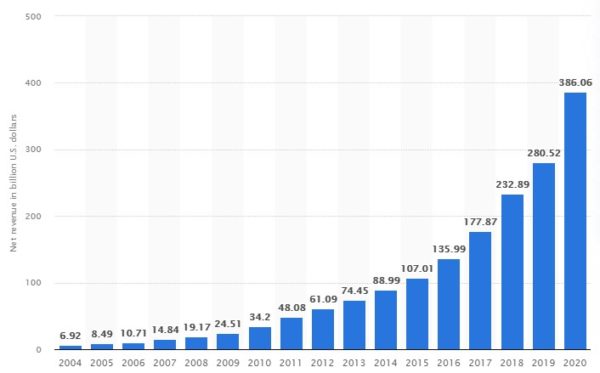
Ecommerce marketplaces like Amazon are breaking their growth records every year. Last year saw Amazon registering a whopping revenue of over $386 billion, per Statista reports.

And the trend seems to go upwards in the coming times. Thanks to the ongoing pandemic and changing customer behaviour. Thus, now seems to be the best time to build your ecommerce marketplace app like Amazon. To help you, here is something that can be highly useful. Read on;

The Step-By-Step Process To Make Apps Like Amazon

Here are the prerequisites to build a multivendor ecommerce platform like Amazon.  

  • Niche Selection:  The primary thing you need to decide is whether your marketplace app would offer all kinds of products like Amazon or focus on a single niche. Furthermore, zeroing in on your ideal market segment and geographical area is also crucial in the beginning. 
  • Budget Projection: After outlining the goals behind your Amazon-like app, you need to draw a realistic budget to set things in motion. First, identify the resources you have, along with the ones you may require, including funding. Doing so gives you a solid budget plan to compare against the actual expenses in the future while refraining you from overspending.
  • USP Identification: What is it that your multivendor app would offer which is not already out there in the market? Why should a user choose your app over your competitors’? Answering these questions will help you identify the unique selling point of your app. Its primary attraction; it could be anything from exclusive products, express delivery to shopping rewards. 
  • Finalization Of Design & Development Teams: Broadly there are two options- hiring freelance ecommerce app developer or choosing an expert ecommerce app development company. Working with freelancers will be time consuming and can be very expensive. The best way it to go for an experience team of ecommerce app developers to build your Amazon like app. Having the right experience and expertise, they can take care of everything. Right from the initial wire-framing to development to testing to the app launch, you get covered all.
  • App Optimisation: Similar to how websites need SEO to rank higher in the search engines, mobile apps also require effective optimization techniques to stay on top of the app store’s search results. Therefore, take out time to research how your competitors are ranking up and the keywords they’re using. And accordingly, devise your strategies. Alternatively, you could also ask your app development team to take care of the app store optimization (ASO). However, that may increase your total cost.  
  • Marketing & Promotions: If people don’t know that your multivendor mobile app exists, how would they even use it? That’s why it is critical to have all your advertising and marketing plans, from digital marketing through social media to print ads, in place.  

How Ecommerce Apps Like Amazon Work & Make Money?

Generally, apps like Amazon and eBay are confused with online stores. However there is a major difference between these two. Having your ecommerce online stores allows you to offer your own goods and services. It is a single vendor store where you can set the price, track the payment, decide the delivery model, and do more. But with a multivendor marketplace like Amazon, you enjoy a lot more.

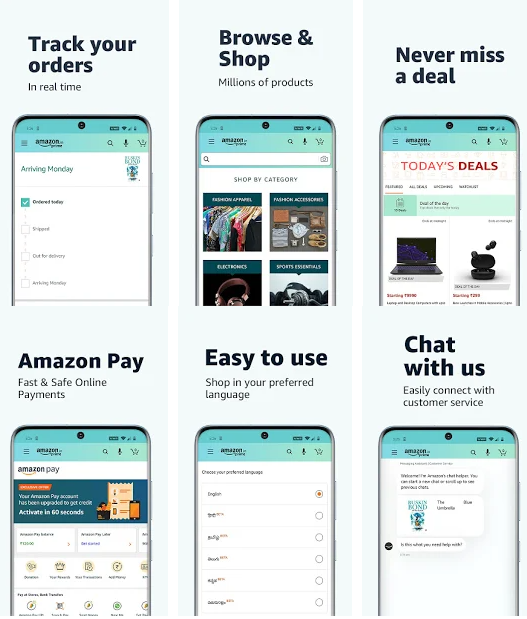
It gives you the ability to have independent sellers who can further list out their services or products, independently. In the simplest terms, Amazon is a multivendor ecommerce application that connects multiple sellers to multiple users. It empowers the vendors or suppliers to enlist and sell their products online. On the contrary, it provides users an easy way to shop, pay and review products online. 

Wondering, how apps like Amazon make money?

The multivendor app owner gets a cut on every order as a commission while the sellers would receive the rest. Apart from that, Amazon-like apps generate revenues through vendor registration/selling fees, paid user subscriptions against special perks, advertising, exclusive brand partnerships, and shipping fees.    

For those planning to build ecommerce marketplace platform, it is crucial to understand the features that make the apps like Amazon hit among users.

What Are The Features To Make Apps Like Amazon?

In order to create your ecommerce marketplace app, here is a list of powerful features to include. Have a look:

  • Easy Registrations:  Signing up on the app, both for the customers and vendors, has to be easy. To make it simpler, allow registrations through social media accounts on your ecommerce app. 
  • Quick Search & Suggestions: A must-have feature- the quick, advanced search enables customers to find what they’re looking for in split seconds, increasing the chances of a purchase. At the same time, your app should recommend relevant items to users based on their shopping history and preferences. 
  • Secured, Multiple Payment Options: For a seamless buying experience, users must get to choose from multiple payment options – from net banking, COD and UPI payments to debit and credit cards.  Get these integrated when building your apps like Amazon.
  • Clutter-Free Shopping Cart Page: The app must provide users with an uncluttered shopping cart page with accurate details of the items added, total costs, shipping charges, and room for product addition and deletion.   
  • Simple, Fast Checkouts: When shopping online, people want every page to load in the blink of an eye. And the transaction process isn’t an exception. So, make sure your users can make swift payments with 100% security.
  • Integration With Social Media: With social media integration, your customers can share their favourite products with their network, which, in turn, can bring in more traffic and boost sales. 
  • Wishlist: Not all users are instant buyers. That’s why your multivendor app should let users add items they may want to purchase later through wishlists. 
  • Prompt Notifications & Alerts: From shipping updates to the latest offers and discounts, real-time notifications and alerts are vital to keeping the customers informed and engaged with your Amazon-like marketplace app. 
  • Ratings & Reviews: Since many purchases happen after exploring customer reviews & stories, it is a feature you cannot do without.  
  • Hassle-free Order Management: This one is really important for vendors. The supplier on your ecommerce marketplace app like Amazon should have a dedicated order management dashboard. It will simplify monitoring and management of all their orders in real-time without any confusions.  

And the list can be very long. Foretasted are some of the essential features for  your apps like Amazon. Want to get the complete feature book to launch, run and grow your ecommerce marketplace platform? Get it here.

How Much It Cost To Develop Apps Like Amazon?

Developing a multivendor app like Amazon could roughly cost you anywhere between $20,000 to $80,000, including a minimum viable product (MVP) and customizations. However, this cost varies with the app’s platform, functions, complexities, features, and the level of expertise of your e-commerce app developers. 

Do you want an exact quote to build app like Amazon? Book Free Consultation! with industry experts right now.

Categories
E-commerce

How To Launch eCommerce App Like eBay: Features Of Online Marketplace App & Cost To Build eBay Clone

Do you want to launch your ecommerce app like eBay but are not sure about how to start? Are you wondering about what features should be included in an online marketplace app and what will be the cost of developing an eBay clone? If yes, then you are in the right space.

eBay is a popular online marketplace and the graph of growth for eBay has been on the rise ever since the ecommerce app was launched. As per a report by Statista, the net revenue of eBay was reported to be more than $10M for FY2020. These numbers are awesome enough to pique the interest of entrepreneurs and lure them to start their own ecommerce app like eBay.

Before moving forward to answer your questions about launching eBay clone app, it is first important to shed some light on eBay business model. eBay business model has evolved from being a bidding platform to a multi-vendor online marketplace.

What Is Multi-Vendor Online Marketplace?

A multi-vendor online marketplace can be defined as a platform that connects customers and sellers while allowing buyers to search products offered by different sellers to compare their price, description and other features to make informed purchase.

While this article is primarily focused on steps to launch online marketplace app like eBay, click here to know about eBay business model and revenue model.

Steps To Launch Online Marketplace Like eBay

Launching your own eBay clone is not an overnight journey. It requires thorough diligence and research. Here are some steps to make this journey simpler for you:

Define Your Niche: If you are planning to launch your own online marketplace like eBay, the first point to consider is that ecommerce giants like eBay and Etsy cover multiple market segments and have earned consumer trust over the years. So, in order to compete against ecommerce apps like eBay, you need to focus on a unique and less explored niche. Also, define your marketing strategy to focus on your USP for gaining customer attention.

Choose Your Revenue Model: Once you have defined your niche, the next step is to focus on one of the most important aspects of starting a business – monetization. You can choose from different business and revenue models. Some popular revenue models are commission based model, membership fee model, listing fee model, ads business model, etc.

See Also: 6 Most Efficient Marketplace Business Models To Boost Revenue

Choose Your Strategy: In the beginning, every online marketplace suffers from dilemma, whether to sign up more vendors first or to build a consumer base first. To answer this query, experts suggest starting small with a number of high-value users. Market your idea to spread awareness and then follow up by setting time or demand constraints. In the beginning phase of launching online marketplace, it is important for every entrepreneur to know the knick knacks of starting the business.

Build Your Online Marketplace App: The next step is to provide a platform to facilitate connections between the sellers & buyers. For launching your online marketplace like eBay, it is first important to select a reliable domain name. After deciding the domain name, define the key features of the ecommerce marketplace. When building app like eBay, focus on following basic features –

  • User or seller authorization
  • Product catalogue
  • Advanced product search
  • Inventory management
  • Admin dashboard
  • Shopping cart
  • Multiple payment integrations
  • Live chat support
  • Real time analytics
  • Shipping & delivery options
  • Easy checkout
  • Order details
  • Discounts & special offers

How To Build Ecommerce App Like eBay?

When starting your online marketplace like eBay, you need to focus on four different interfaces.

  • Customer/Buyer Interface
  • Vendor/Seller Panel
  • Admin/Dispatcher Panel
  • Agent/Driver Interface

Let’s discuss features that need to be included in these interfaces of an eBay clone.

Customer/Buyer Interface: The customer or buyer interface has to be designed and loaded with features that will help in ensuring a simple buying experience for the buyers. This is necessary to ensure returning customers for generating higher ROI for your online marketplace. Here is a list of features that should be included in the customer app:

  • Easy sign up & login
  • Advanced product search with multiple filters
  • Push notifications for order confirmation & delivery status
  • Real time order tracking
  • Multiple payment mode integrations
  • Ratings & reviews

Vendor/Seller Panel: The vendor or seller panel should allow the sellers to update the available products and easily manage product listings with features to upload details including product images on the online marketplace. It should be loaded with features that allow seamless order acceptance and fulfillment. Make sure to include following features in the vendor/seller panel of your ecommerce marketplace like eBay:

  • Product catalogue management
  • Instant updates
  • Order dashboard
  • Business reports
  • Manage listings

Admin/Dispatcher Panel: The admin or dispatcher panel should include features that allow you a better control over the operations of your ecommerce marketplace like eBay. Additionally, it should also provide insight into the user behavior, order completion, order stats, etc. for better understanding of the performance of your ecommerce marketplace. In order to have a power packed admin panel, make sure to include following features in your eBay clone:

  • User & agent management
  • Automated task assignments
  • Real time analytical reports
  • Deals & offers management
  • Push notifications

Agent/Driver Interface: Logistics and delivery are an important part of running an online marketplace. This makes agent/driver interface an integral part of your ecommerce marketplace app. It should be designed with features essential to facilitate seamless delivery for the agents as well as the customers. An intuitive agent or driver app should include following features:

  • Easy driver onboarding
  • Delivery alerts & details
  • Availability status update
  • Location & route optimization
  • Proof of delivery
  • Daily earnings section

See Also: How To Make Ecommerce App Like Amazon- Features, Business Model & Cost

What Is The Development Cost Of eBay Clone?

The development cost of eBay clone app depends upon numerous factors such as the UI/UX of the ecommerce marketplace app, list of features of online marketplace, location of the development company, operating system compatibility with Android/iOS, etc.

Depending upon these factors the development cost of eBay clone can range from $5500 to $12,500 per platform. Code Brew Labs offers an affordable solution! As leading online marketplace app developers, we offer ready-to-use solution for developing your eBay clone. The ready-to-use solution can be customized to meet your needs and as most of the solution is pre-written, it reduces the development time and cost.

Do you want to launch your eBay clone at an affordable cost with low launch time? Let’s connect now!

Watch this live demo of Code Brew’s Ebay Clone App

Categories
E-commerce

How To Run A Successful Ecommerce Business Despite Of Industry Giants Like Amazon, Flipkart, Myntra?

The e-commerce industry has been witnessing a boom worldwide, growing at an unprecedented rate all across the globe. According to a report, in 2019, 14.1% of the total global retail sales were made online. Another interesting finding highlights that marketplaces represent 50% of the total ecommerce sales globally, growing at an annual rate of 35%, compared to about 15% overall for ecommerce.

Interestingly, it has also been found out that 31% of first-time shoppers prefer to buy on online marketplaces. Witnessing such exciting trends and patterns, it is clear that more and more online marketplaces are willing to venture into the once not-so-crowded e-commerce space.

However, the industry is currently brimming with competition, boasting of quite a few successful online ecommerce marketplaces like Amazon, Flipkart, Myntra and many others. Budding entrepreneurs must make a note of the below mentioned points, in order to run a successful online ecommerce marketplace and compete against the existing ones.

A Powerful User Experience

Deliver an experience strong enough to draw the consumer back to your platform and ensure them wanting to stick for long. User experience could certainly act as a key differentiator, and could draw a clear line between your marketplace and the others, thereby leading to conversion of visits into actual sales.

Source: Forbes.com

Thus, it is important to build a robust framework by diving deep into different aspects – create a simple and impactful design, a user-friendly interface and add personalisation to your overall approach. Again, a recent report has revealed that brands who deliver more personalised product recommendations witness their engagement rise by 70%. These recommendations could be made post analysing consumers’ wish-list, past shopping history, search pattern, etc.

Moreover, marketplaces must ensure a seamless product discovery and search experience for their consumers by making their platform easily navigable. Users should be able to search for their required products effortlessly, compare options, and be able to complete their purchase in the shortest period of time.  The simplicity and friendliness of the platform should actually entice customers to maintain a long-term relationship with your brand. The e-commerce mammoth, Amazon, for example, has been successful in engaging a diverse target audience for over 25 years due to its amazing search technology and user experience. 

Never Compromise On Quality

Create a strong product offering on your marketplace and ensuring supreme quality in all the areas. Maintaining consistent product quality could help you forge better relations with your customers and also drive successful operations of a marketplace. The use of leading technology, up-to-date mobile app, robust delivery framework, etc could draw you closer to achieving your objective.There have been many instances where consumers have gradually moved away from marketplaces, being dissatisfied with the product or the quality of services rendered.

Studies have also revealed that the second biggest reason why a customer ditches any particular brand, after customer experience, is due to dissatisfaction with the product itself. Customer retention, in that case, become a key challenge, which eventually leads to shrinking of the customer base and causes a huge dent on the reputation of the marketplace. Not a very desirable scenario!

Customer Data Matters

Gather all crucial information and data about your customers – their specific tastes, their previous order history, their buying pattern, search pattern, etc. This information could be used to tailor and design unique, personalised shopping experiences for each customer individually. The insights from this data could also be used to design appropriate marketing strategies, and target or re-target consumers in the most effective way. A recent research conducted by McKinsey states that companies that use customer data to inform their practices witness 85% more sales and 25% greater gross margins as compared to those who don’t make use of their data. The data of visitors on your platform could also be used for other influential activities aimed at converting them into customers. 

Excellent Customer Service 

A great customer service indisputably plays a paramount role in customer retention and loyalty, and could eventually draw some great sales numbers for your business. Of all the e-commerce marketplaces that exist today, the truth is that a large number of them still experience several major issues in their customer service. Caught up with serving a wide customer base, resolving all customer complaints, queries and grievances still remains a key challenge for many of them.

So, here’s where you could differentiate – create an outstanding customer support system, which reaches out to your users and addresses all their concerns in the quickest way possible. Know what your consumers want, collect their feedback on a regular basis and act upon it, offer free shipping for their goods, deliver impromptu gestures to loyal customers like sending greeting cards on their birthdays, etc. Keep improving your customer service  with time, and it would certainly pay off!

Keep Innovating

We are in the midst of a rapidly advancing era, where innovation has almost become a daily phenomenon in all types of businesses. With continuous advancements in technology, customer expectations, and industry trends, it is important for marketplaces to stay abreast and keep evolving by speedily responding to the changing trends and technology.

An idea or offering which works pretty well with the consumers today might become obsolete very soon. For example, consumers might stop rejoicing a particular way of delivery, and start to look for better alternatives, which perhaps others in the industry could be offering. In such cases, marketplaces have to be quick enough to introduce such changes in the system well before in order to ensure consumer satisfaction. Ensure newness in the system at all times in order to keep the excitement of the consumers alive and ticking. 

Gazing into the future, it would be right to say that online sales, along with online buying, will continue to increase. In 2018, the global e-commerce sales amounted to USD 2.8 trillion, which by 2021 is expected to grow to USD 4.8 trillion. Entrepreneurs who are planning to enter the budding market with their unique marketplace model – the time is now! Get in touch with us; we will help you make the most of it.

Categories
E-commerce

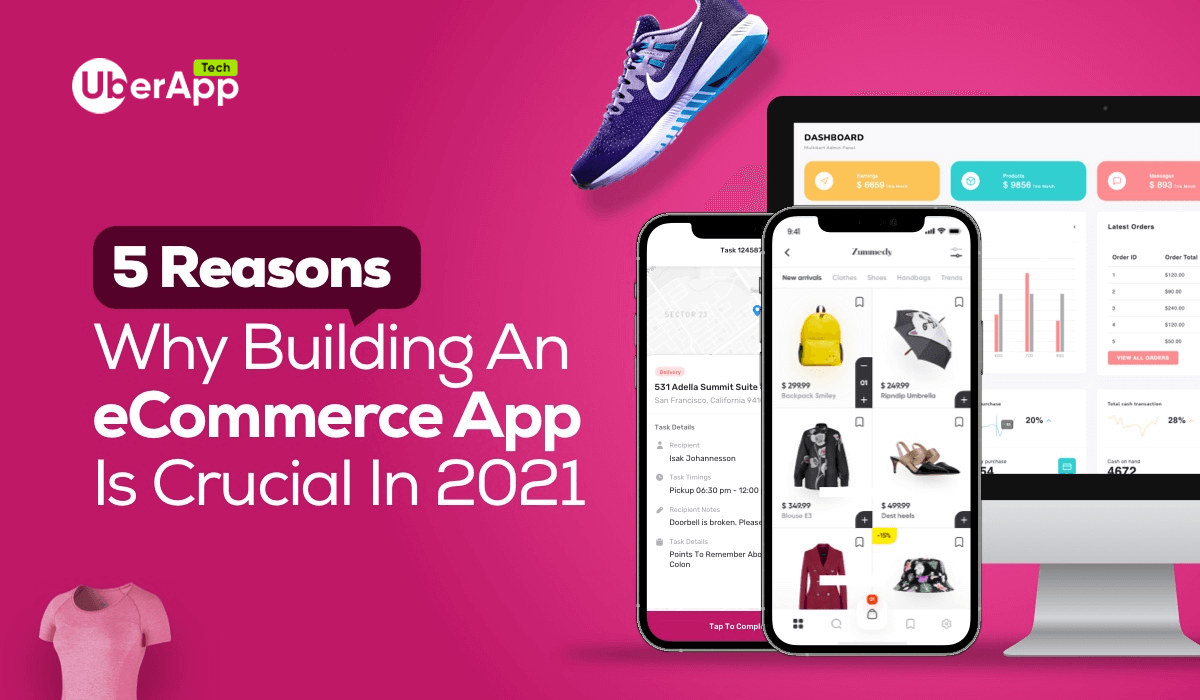
Why Building An eCommerce Business App Is Crucial For Businesses in 2021?

2020 has been a year of Ups for some and Downs for some eCommerce businesses. By now, not many would have witnessed the change in the market around, and this time, it’s quite a significant one. According to Statista, smartphone users are expected to reach 4 billion worldwide or may even cross the number by the end of 2021. With this change in how people are going to interact in the new normal, one can surely see new business aspects and profits up for grabs for everyone, if one is willing to take it. Thinking to build an eCommerce app of your own?

For any successful online marketing campaign, mobile apps are already an indispensable feature. The device from which we access the Internet the most is the smartphone. That has inspired many business owners to create and develop numerous mobile apps to ensure their marketplace doesn’t go down. Mobile marketing has become one of the most relevant marketing tactics and an eternal part of business investment.


A Mobile App is Necessary for an Effective Market Presence

One day without a cell phone would be strenuous for all of us to imagine. An important question for all business owners now emerges from that conclusion: Do you think it’s good for your brand to be present on someone’s smartphone 24/7?

Some smartphone apps have certainly become indispensable in our lives. For everything that has to do with the work environment, we use apps. And several apps are so deeply embedded into business processes that it is unimaginable to think about completing tasks without them.

Having a customized mobile app and being present on the customer’s smartphone implies occupying a privileged status. Experience from successful business models has shown us that mobile apps have become a great help for customer service and an indispensable tool, both for employee-customer relationships and for business and economic growth.


A Mobile App means Direct Contact with Customers

Getting your mobile app helps you to keep in contact with your staff and customers anytime, anywhere. In this way, it ensures that you connect efficiently, safely, and easily. It is a way for employees to better manage and organize time, which implies both cost savings, teamwork, and higher productivity.

Still, when we speak of potential clients, the situation is simply not the same. Having direct and personal contact with them puts you in a position of confidence and interest. This implies that not only would you need to satisfy their expectations or solve problems, but new markets and potential clients can be opened or accessed.

Customers prefer to use a smartphone application to access your business services (just by clicking a few icons) that will take them directly to the services or items they are interested in without opening a window, writing web addresses, or using search engines. It takes less time and effort, and next to the low price, which is exactly what every client needs the most, regardless of the type of business.


A Mobile App Influences the Customers

A mobile application boosts the company’s status. This enables you to be updated at all times right at the moment. This makes it the most effective reason to build an eCommerce app for any business.

It is, above all, an advertising tool.

With the symbol that distinguishes you, the image of your business will be clear at all times. In this way, when you remind the user of your presence, both when using the mobile application and when performing other actions in the terminal, you can control the minds of customers.


A Mobile App Enhances your Brand

The mobile app boasts the company’s expansion effectively. Your application must be intuitive and functional, manageable, and above all, open to customers for this purpose. Based on the type of business you run, it’s about designing a mobile marketing plan.

You can customize the image of your brand. Think about finding out how and what the right way to deal with your clients is.

Figuring out a successful form of the business mobile app is harder than it seems. Before finding out how can you aid the consumers every day, you would need to slowly go through different details. Think of the ultimate objective that would translate into satisfaction and purchasing.


A Mobile App Positions your Brand

Group of people working on website template

Of course, it is now clear that changes and technical advancements go hand in hand. Your business or the mobile app must always be up to date. Not only in terms of content, but in terms of code and development. You need to update the software to the new versions of the operating systems, as well as take into account feedback, fix mistakes, assess performance, and improve compatibility for the customers. This would ultimately lead to the better positioning of your brand in the competitive market.

Finally, it can boost SEO placement by providing a smartphone app for your company, as the inclusion in mobile application stores, such as the App Store, Google Play, and Windows Phone Store, generates an improvement in the amount of organic mobile phone searches.


Summary

Smart devices are used by customers to access the Internet and make payments more than ever. Understand that it is now a fact for mobile marketing and investment in the development of mobile apps for enterprises or corporations. You can’t neglect the investment in the development of the mobile application if you handle marketing within your organization, as it can prove to be an efficient strategic strategy for your business development.

Here at Code Brew Labs, we believe that businesses need to adapt to the current and obvious future of the nature of eCommerce to retain their formidable market position and invest in the development of a custom mobile application for their company. Get In Touch with us to build your own 7-star eCommerce app and rule the market just in a click.

Wait! Looking To Build An App Like Uber?

It's Time To Convert Your Uber Like Business Idea Into Success!

Get Free Consultation From Top Industry Experts:
gif
I would like to keep it to myself